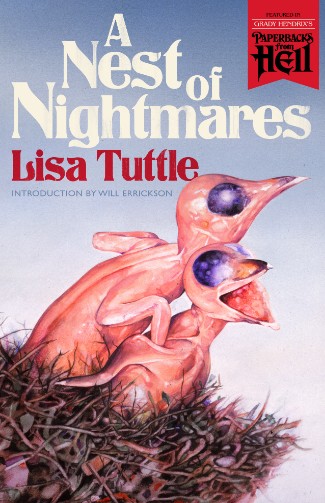
It began with a podcast. Specifically, an episode of Reading Writers in which guest Nicholas Russell discussed several authors of uncanny fiction whose work he admired. One of them was Lisa Tuttle; I’d read two novels of hers: My Death, which NYRB Classics reissued in 2023, and The Mysteries. Russell’s comments piqued my interest, which led to my ordering Valancourt’s reissue of her 1986 collection A Nest of Nightmares.
First thing first: yes, that cover is utterly terrifying. It’s by Nick Bantock, in his pre-Griffin & Sabine days. As Will Errickson notes in his introduction, this collection focuses on Tuttle’s more overly horrific work — something that the opening story, “Bug House,” makes clear. This story and the one that follows, “Dollburger,” are built around particularly striking images, unnerving enough to send a chill down one’s spine.
If that was all Tuttle was up to here, that would be fine; the first story is a kind of haunted house tale that reveals itself to be something very different, while the two stories that follow depict innocent characters meeting unsettling fates. As you make your way into the collection, though, another side of Tuttle’s work comes to the foreground: a sense of mystery and atmosphere.
Some of this comes from Tuttle knowing how to meticulously cultivate a slow-burning narrative. “The Other Mother” shares an interest in myth and folklore with her novel The Mysteries, but it also contains a thread of narrative ambiguity. Its protagonist Sara sees a figure that seems archaic, with an interest in her children. Precisely what that interest is doesn’t become clear until the conclusion, which features a devastating moment of revelation.
For me, the high point of the book was “Flying to Byzantium,” about Sheila, an ambitious writer who visits a science fiction convention in a small Texas town. She’s the guest of honor there, but upon her arrival, things seem somehow wrong — beginning with the odd dynamic between the two women who meet her at the airport, Victoria and Grace, and escalating from there.
Just shy of a decade ago, I wrote about Rachel Ingalls’s novella “Friends in the Country,” a notable example of a strain of uncanny fiction where manners and socializing have turned sinister. “Flying to Byzantium” absolutely falls into this realm: as Sheila visits a place that seems both familiar and utterly alien, her own ambitions and memories become increasingly menacing. There’s a kind of dream logic to this story, with each new wrinkle revealing more and more of Sheila’s psyche.
What makes this story particularly notable is the character of Sheila herself. Though she’s in some form of peril, she’s also a deeply flawed protagonist — one who saw writing as a means to an end rather than a rewarding act all its own. It’s notable that, of these stories, this is the one that seems the most moralizing — but Sheila’s crime, as it were, is not a social transgression but instead the squandering of what seems to be genuine skill at her craft. It’s a haunting trip in a book full of them.
 Notes, thoughts, & miscellany
Leave a comment