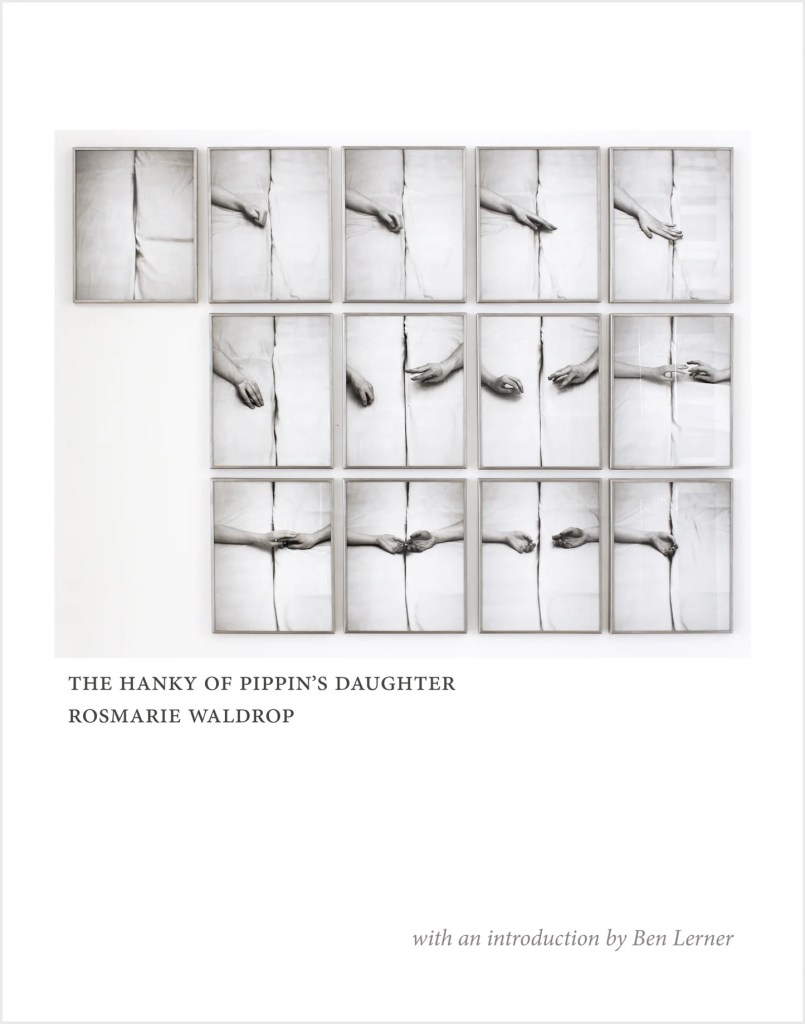
I can’t say precisely why, but I’ve been on a short story collection kick lately. Maybe it’s been Aaron Burch’s story-centric newsletter; maybe it’s because I’m looking to write more stories and have been looking for ways to be inspired. So I’ve also been trying to make a dent on my many to-read shelves, and that’s…how I ended up falling for a book that is not a short story collection at all.
I’m going to pin this on Lydia Davis’s blurb, who referred to the “several overlapping tales” found in Rosmarie Waldrop’s The Hanky of Pippin’s Daughter. Either way, I read it — thinking maybe I was getting a novel in stories — and left the experience floored. For a few reasons, actually.
One of those reasons is best articulated by Ben Lerner’s introduction, which The New Yorker published in 2019. Lerner refers to Waldrop’s practice of using “destabilizing section headings” throughout the book, which both interrupt the flow and redirect it. I haven’t seen this technique used to this effect ever before, really, which lent a playful element to the whole book.
That’s especially notable, because the themes Waldrop is pursuing here are anything but playful: lies within a family; adultery; the loss of religious faith; and, to top that all off, the rise of fascism. This is a novel largely about events taking place in Germany between the wars, narrated from several decades later and one continent away.
I have a fondness for novels that create characters by suggestion and implication, and that’s one of the things Waldrop does here: the narrator is recounting this story to her estranged sister, and it’s through these references that the post-war iteration of the family begins to come into focus, even as Waldrop focuses much of the temporal narrative on 1920s Bayreuth.
At the center of this novel is a marriage and a friendship marred by infidelity: Frederika’s affair with her husband Josef’s friend and fellow World War I veteran Franz. Franz is Jewish; Frederika and Josef are not, and if you think that the timing of this affair and its aftermath might take on grimmer tones due to the timing, you’d be absolutely correct.
If this was the only story Waldrop was telling, it would be powerful enough. But in telling the story of Frederika and Josef’s children and how they have reacted to both the flaws in their parents’ marriage and Germany’s descent into fascism, Waldrop refracts that core tension in several ways. That she is able to do this through implication, creating hints of decades-long lives through inference and suggestion, is one of several elements of this novel that make its craft particularly potent.
But it’s also memorable for its potent use of timing and language. The end of this book hits especially hard, the combination of narrator’s voice and historical context dovetailing in devastating fashion. Waldrop’s novel of an imperfect marriage, paradoxically, achieves a perfect marriage of form and content. It’s stunning work.
 Notes, thoughts, & miscellany
Leave a comment