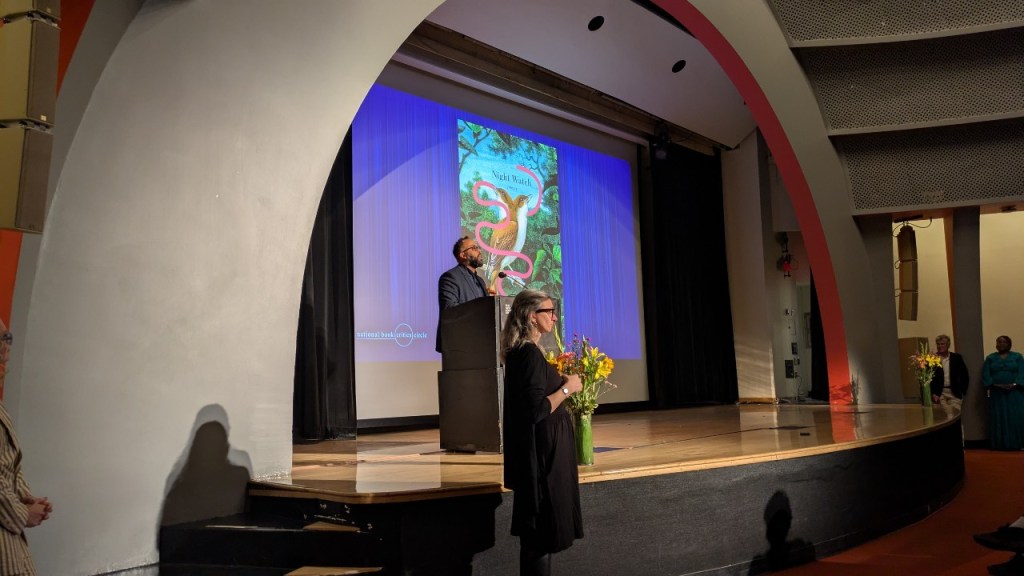
On Thursday, the National Book Critics Circle Awards for publishing year 2025 took place. Publishers Weekly has an excellent write-up of the event, which I highly recommend checking out. I should stress that I am not at all objective here: this is my second year on the NBCC board, and I’m extraordinarily proud of the work we did.
My memories of last year’s award ceremony are a little hazy for one reason: it turns out I was coming down with COVID-19 that week, which left me borderline delirious at the time. At this year’s ceremony and finalist reading, I noticed a couple of themes coming into focus that weren’t necessarily present as the long lists, and then the short lists, came together.
One of these was a general resistance to AI, and to unrestrained technology in general. Most notably, this came via Karen Hao’s win in the Nonfiction category for her book Empire of AI: Dreams and Nightmares in Sam Altman’s OpenAI — but it was also present in Liz Pelly’s John Leonard Prize-nominated Mood Machine: The Rise of Spotify and the Costs of the Perfect Playlist, which critiques Spotify’s approach to the music industry and its business practices. Quinn Slobodian was also critical of the tech world and companies that played fast and loose with copyright law when he gave his acceptance speech for Hayek’s Bastards: Race, Gold, IQ, and the Capitalism of the Far Right, which won for Criticism.
Another recurring motif, at least in the acceptance speeches, involved the amount of time several of these books took to come to fruition. In accepting the Leonard Prize for Baldwin: A Love Story, Nicholas Boggs shared that the book had been twenty years in the making. Kevin Young discussed the many years it took for Night Watch to be written, and how the pandemic had prompted him to believe this was the appropriate time for it. And Alex Green, in accepting the award for Biography for A Perfect Turmoil: Walter E. Fernald and the Struggle to Care for America’s Disabled, contrasted his belief of a decade ago that he wasn’t writing a biography of Fernald with the reality that he had done exactly that.
There’s almost certainly more analysis to do here, though I’m probably too close to the process to be the one doing it. Chad W. Post has done some excellent deep dives into literary awards, as has Alex Shephard; I’ve even engaged in a bit of it myself, in my pre-NBCC board days. But this year’s award cycle has also been a quiet sort of revelation for me: that awards as just as interesting to me from the inside as they’ve been as an observer.
 Notes, thoughts, & miscellany
Leave a comment