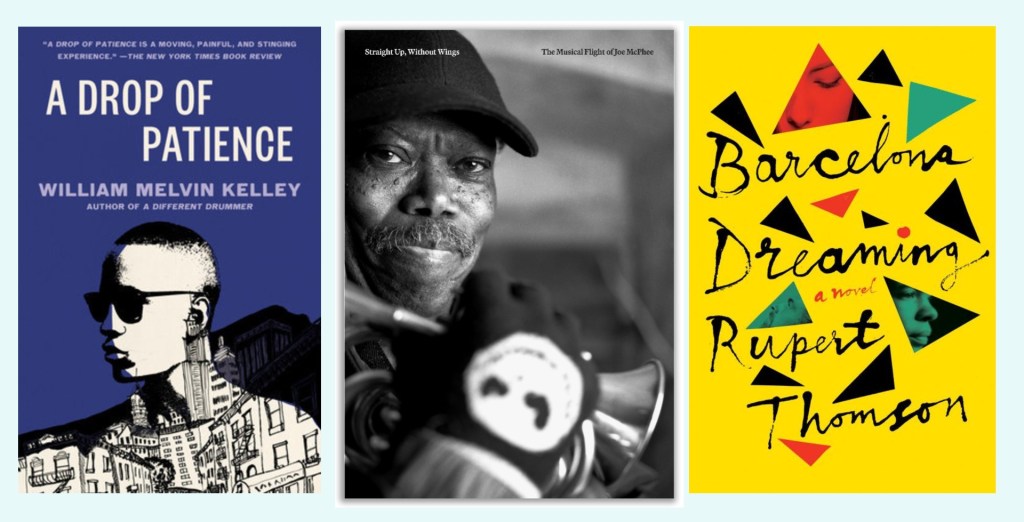
I’m back from this year’s AWP, which was an excellent time. And I have brief thoughts on three books with one big element in common.
William Melvin Kelley, A Drop of Patience
Joe McPhee as told to Mike Faloon, Straight Up, Without Wings: the Musical Flight of Joe McPhee
Rupert Thomson, Barcelona Dreaming
Sometime after its publication in early 2018, I read Kathryn Schulz’s excellent New Yorker article on the works of William Melvin Kelley; later that year, on a visit to Edinburgh, I picked up a copy of Kelley’s excellent novel A Different Drummer. I’d always intended to read more of Kelley’s work, and Anchor’s new editions of his bibliography gave me the chance to do exactly that.
A Drop of Patience is, essentially, a character study of a brilliant jazz musician, Ludlow Washington. Besides his talent as a musician, Ludlow is blind; one of the subtly understated aspects of Kelley’s prose is the way that he ushers the reader into Ludlow’s perspective. In many a novel, physical descriptions of characters frequently appear; in Kelley’s use of language, he focuses instead on voices and demeanors. It’s a restrained but effective way of building empathy for Ludlow, whose life as a Black man in the U.S. in the mid-20th century is fraught in many ways, but who is also capable of mercurial behavior towards others.
Brief flashes of prose suggest a time after many of the novel’s events when Ludlow is recognized for his abilities as a musician. The tormented jazz musician can easily become a cliched character; Kelley avoids that here while also evoking both Ludlow’s perceptions and his music through a precise use of language. It’s a quietly stunning feat.
I’m not sure when I first encountered Joe McPhee’s music, though I’ve had Atavistic Records’ edition of his album Nation Time in my collection for ages now. (I’m guessing it has to do with being a reader and occasional contributor to the early-2000s publication Copper Press, but I could be wrong.) McPhee’s collaborator on the book Straight Up, Without Wings: the Musical Flight of Joe McPhee is the writer Mike Faloon, who – full disclosure – is a friend.
McPhee’s book is a fantastic chronicle of a long life in music; one of the details that comes from reading it is a sense of just how he can zero in on specific sounds, sometimes evoking them using his own music and sometimes incorporating them into his work. There are also plenty of appearances from other notable artists, including Cecil Taylor, Pauline Oliveros, and Rachel Pollack. (Plus contributions by both Fred Moten and Moor Mother.) It’s a memorable guide to one musician’s artistic influence and evolution – and a book that should inspire many a deep dive into its author’s discography.
There’s a very different sort of jazz musician to be found in the pages of Rupert Thomson’s Barcelona Dreaming. Everything I’ve read from Thomson is vastly different from what’s come before it, a quality that he shares with McPhee and Kelley. “The King of Castelldefels” is this novel’s middle section; each of the book’s three parts shows the titular city from the viewpoint of a different character. Ignacio “Nacho” Gomez Cabrera is the narrator of this section, and what ultimately rises to the surface is a sense of squandered potential.
Nacho is an enthusiastic musician but one whose habits are uneven. We meet him in dissolute middle age; to say that he isn’t an entirely reliable narrator of his own life is clear from the outset. But his enthusiasm for jazz, including the music of Keith Jarrett, is clear, and there’s a sense that his life might have been very different had he pursued his passion earlier on. (Alternately, it’s also possible that his appetites might have undone him sooner.) It’s an interesting route Thomson takes here, providing a haunted look at the road not taken by showing us its inverse. You could probably write a song about it.
 Notes, thoughts, & miscellany
Leave a comment